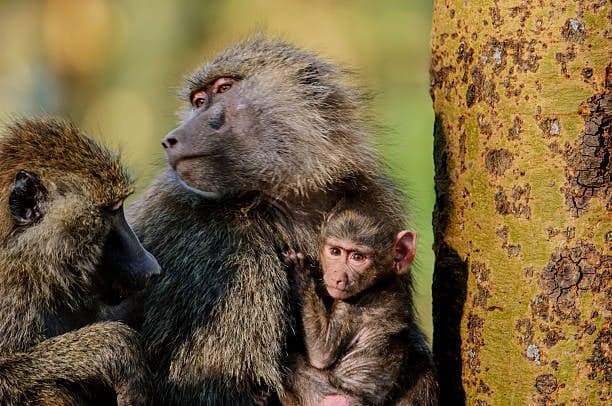
Baboons are among Africa's most widespread and intelligent primates. Belonging to the genus Papio, they are closely related to humans and are known for their advanced social structures, communication skills, and remarkable adaptability.
There are six recognized baboon species, including the Olive Baboon, Yellow Baboon, Chacma Baboon, Guinea Baboon, Kinda Baboon, and Hamadryas Baboon. In East Africa, the Olive Baboon and Yellow Baboon are the most commonly encountered species during safaris.
Baboons are highly social animals that live in large groups called troops, which may range from a few individuals to more than 200 members. These troops are organized through complex social hierarchies and family relationships that help ensure protection and cooperation.
Recognized by their long snouts, powerful jaws, expressive faces, and strong limbs, baboons spend much of their time on the ground while also possessing excellent climbing abilities. They are highly adaptable and can survive in a wide range of environments, from open plains and forests to rocky cliffs and mountain regions.
As omnivores, baboons consume a diverse diet that includes fruits, seeds, leaves, roots, insects, birds, eggs, and small mammals. Their opportunistic feeding behavior has helped them thrive in various ecosystems across Africa.
Baboons communicate through vocalizations, facial expressions, body posture, and grooming behaviors. Grooming is particularly important as it strengthens social bonds and reduces tension within the troop.
Although often playful and entertaining to observe, baboons are highly intelligent wild animals that should always be respected. Their complex social lives and human-like behaviors make them one of the most fascinating animals to encounter on safari.
Where Can You See Baboon on Safari?
Baboons are highly social and easily found near woodland, water and rocky ground. Large troops are common in the Serengeti National Park, Kenya's Lewa Conservancy and Meru National Park, and throughout Uganda's Queen Elizabeth National Park, Murchison Falls National Park and the foothills of the Rwenzori Mountains National Park.
When Is the Best Time to See Them?
Baboons are active by day throughout the year, so sightings do not depend on season. Mornings and late afternoons are the liveliest times to watch troop behaviour, and the dry months make roadside and waterhole gatherings especially easy to observe.