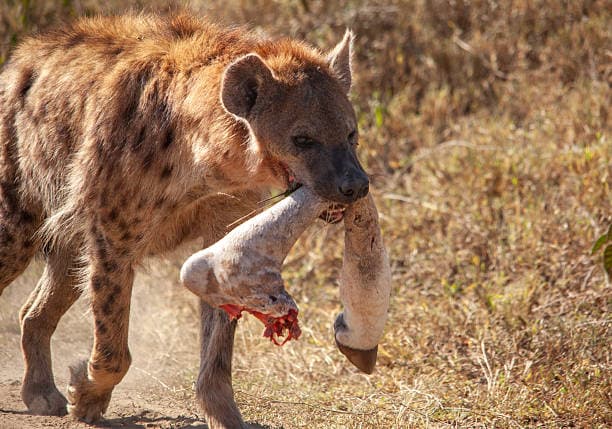
The Spotted Hyena (Crocuta crocuta) is one of Africa's most remarkable predators and among the continent's most successful carnivores. Often misunderstood as merely scavengers, hyenas are highly skilled hunters capable of taking down large prey through teamwork, endurance, and intelligence.
Recognizable by their sloping backs, spotted coats, rounded ears, and powerful jaws, hyenas are perfectly adapted to life on the African savannah. Their jaw strength is among the strongest of any mammal, allowing them to crush bones and consume nearly every part of a carcass, including bones and hooves.
Spotted Hyenas live in large social groups called clans, which can contain anywhere from 10 to more than 80 individuals. These clans are led by dominant females, making hyena societies among the most complex matriarchal systems in the animal kingdom.
Hyenas are highly intelligent and exhibit advanced problem-solving skills, cooperation, communication, and social learning. Their famous "laughing" vocalization is actually a form of communication used during excitement, conflict, or feeding interactions.
Contrary to popular belief, studies show that hyenas often hunt more successfully than lions. They prey on wildebeests, zebras, gazelles, antelopes, and other animals, while also scavenging opportunistically.
As apex predators and scavengers, hyenas perform an essential ecological role by controlling prey populations and helping recycle nutrients through the removal of carcasses.
For safari visitors, witnessing a hyena clan, observing a nighttime hunt, or hearing their eerie calls across the African plains provides a truly unforgettable wildlife experience.
Where Can You See Hyena on Safari?
Spotted hyenas are widespread and often seen around dens or trailing the big cats. The Serengeti National Park and Ngorongoro Crater Park support large, well-studied clans, while Kenya's Lewa Conservancy, Meru National Park and Lumo Community Wildlife Conservancy offer regular encounters. In Uganda they are found in Queen Elizabeth National Park.
When Is the Best Time to See Them?
Hyenas can be seen throughout the year, but they are most active at night and in the cool of early morning, so dawn game drives give the best chance. The dry seasons heighten activity as clans follow the concentrated herds and scavenge around predator kills.