Flamingos are among the most iconic and visually stunning birds in the world. Their brilliant pink coloration, long necks, slender legs, and synchronized flock movements make them one of Africa's most celebrated wildlife attractions.
East Africa is home to two species of flamingos: the Lesser Flamingo (Phoeniconaias minor) and the Greater Flamingo (Phoenicopterus roseus). The Lesser Flamingo is more numerous and is particularly famous for forming massive colonies along the alkaline lakes of the Great Rift Valley.
The characteristic pink color of flamingos comes from pigments known as carotenoids found in the algae, cyanobacteria, and crustaceans they consume. Birds with richer diets often display more vibrant pink plumage.
Flamingos thrive in alkaline and saline lakes where few other species can survive. Their uniquely adapted beaks allow them to filter-feed on microscopic organisms while standing in shallow water. Large flocks often move together in synchronized patterns, creating spectacular displays that attract visitors from around the globe.
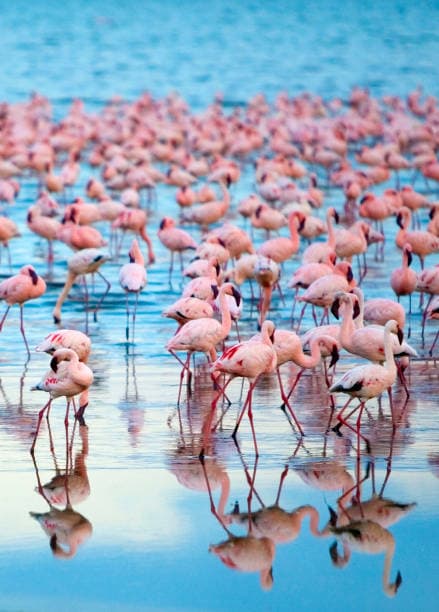
One of the most famous flamingo spectacles occurs in Kenya's Rift Valley lakes, where hundreds of thousands, and sometimes millions, of flamingos gather along lake shores. These gatherings create breathtaking pink landscapes visible even from the air.
Flamingos are highly social birds that breed in large colonies. They construct cone-shaped mud nests and typically lay a single egg. Both parents participate in raising the chick.
Although flamingo populations remain relatively stable, changing water levels, pollution, habitat degradation, and climate change can affect breeding sites and feeding grounds.
For safari travelers, photographers, and birdwatchers, flamingos represent one of Africa's most beautiful wildlife experiences and remain a highlight of many East African tours.
What Is “Flamingo Friendship”?
Flamingo friendship describes the stable, long-term social bonds flamingos form within a flock. Multi-year studies of flamingo colonies show that individual birds consistently choose to stand, feed and preen beside the same companions — bonded pairs, same-sex friends and small cliques — while actively avoiding certain other flock members. These friendships can persist for years and appear to reduce stress and squabbling in large, noisy colonies.
Pair bonds are equally loyal: most flamingos keep one partner through a breeding season, build their cone-shaped mud nest together, and share incubation and chick-feeding duties, with both parents producing nutrient-rich crop milk. In the huge Rift Valley flocks, watch for pairs and trios that move in step, mirror each other’s head-flagging displays and defend a small feeding space side by side — that is flamingo friendship in action.
Where to See Flamingos in Kenya
Kenya’s Great Rift Valley lakes host some of the world’s largest flamingo gatherings. Lake Nakuru National Park is the classic viewing spot, combining flamingos with rhino and Rothschild’s giraffe on one game drive. In recent years Lake Bogoria has often held the biggest lesser flamingo flocks — sometimes over a million birds — because its hot-spring-fed alkaline water produces abundant spirulina. Near Lake Naivasha, the small alkaline Lake Oloiden also attracts flamingos when conditions suit.
Water levels decide everything. Flamingos feed on cyanobacteria and tiny crustaceans that flourish in shallow, strongly alkaline water. When heavy rains raise lake levels — as has happened repeatedly at Nakuru — the water dilutes, food crashes and the flocks shift to Bogoria, Elementaita or Tanzania’s Lake Natron. The drier months of January–March and June–October are generally the most reliable viewing windows, but flocks move between lakes year-round, so a good guide will check current conditions before your game drive.