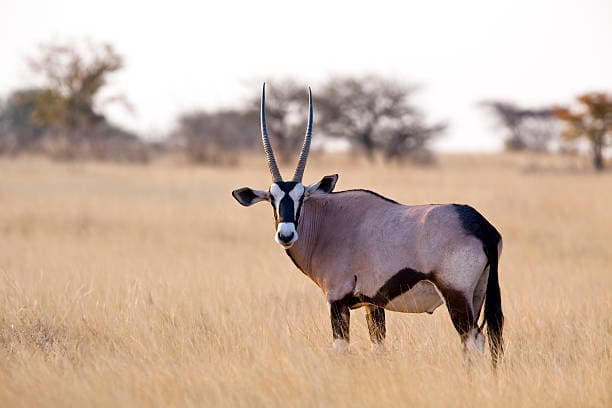
The Oryx is one of Africa's most elegant and resilient antelope species, renowned for its ability to thrive in some of the continent's harshest environments. Belonging to the genus Oryx, these impressive animals are perfectly adapted to life in arid and semi-arid regions where water is scarce and temperatures can be extreme.
In East Africa, the most commonly encountered species is the Beisa Oryx (Oryx beisa), while related species such as the Gemsbok inhabit Southern Africa. Oryx are instantly recognizable by their long, straight horns, pale coats, black facial markings, and muscular bodies.
Both males and females possess horns, which can reach lengths of over one meter. These horns serve as powerful defensive weapons against predators including lions, hyenas, leopards, and wild dogs.
Oryx are among the most drought-resistant large mammals in Africa. They have evolved remarkable physiological adaptations that allow them to conserve water and regulate body temperature. They can survive for extended periods without drinking water, obtaining most of their moisture from grasses, roots, bulbs, and leaves.
Typically living in small herds, Oryx are social animals that move across open landscapes in search of food. Their exceptional eyesight and alert behavior help them detect predators from long distances.
As grazers and browsers, Oryx contribute to ecosystem balance by controlling vegetation growth and serving as prey for large carnivores. Their presence is an indicator of healthy arid and semi-arid ecosystems.
For safari travelers, seeing a herd of Oryx crossing the plains of Samburu or standing against the backdrop of East Africa's rugged wilderness is a truly unforgettable wildlife experience.
Where Can You See Oryx on Safari?
The oryx is a hardy antelope of dry country, and Meru National Park is a strong place to see it against arid scrub. It also ranges into the moorland fringes near Aberdare National Park, and is closely associated with the semi-desert reserves of Samburu and the far north.
When Is the Best Time to See Them?
Oryx are resident and can be found in any month. The dry seasons of June to October and January to March are the most rewarding, when animals move towards reliable water and the sparse vegetation makes the striking, straight-horned antelope easy to spot.