

Mount Elgon National Park is a 1,279 km² park in eastern Uganda, on the Kenyan border about 235 km from Kampala. It protects the Ugandan slopes of Mount Elgon, an extinct volcano more than 24 million years old whose collapsed summit forms the world's largest intact volcanic caldera — roughly 40 km across.
Mount Elgon is among the oldest volcanic mountains in East Africa and once stood taller than Kilimanjaro before millions of years of erosion wore it down. What remains is a vast, gently sloping massif crowned by Wagagai Peak at 4,321 m — Uganda's highest point on the mountain — and cut by cliffs, caves, waterfalls and river gorges.
The park spans a remarkable range of ecosystems: montane forest, bamboo belts, giant heather, alpine moorland and high-altitude grassland. Wildlife includes elephants, buffaloes, bushbucks, duikers, giant forest hogs, blue monkeys and black-and-white colobus monkeys. The mountain's caves provide one of its most curious spectacles — elephants enter Kitum and neighbouring caves to gouge mineral salts from the walls with their tusks.
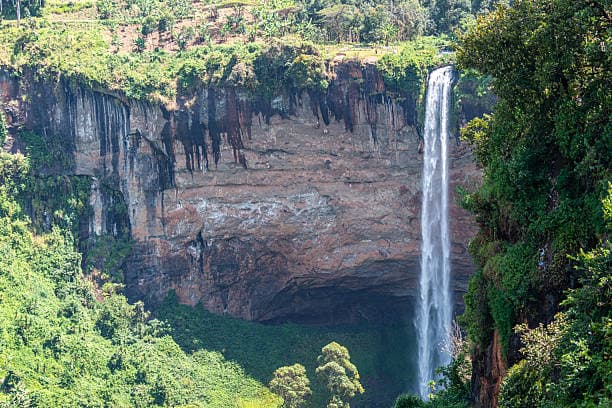
Sipi Falls, a series of waterfalls tumbling down the mountain's northwestern foothills, is one of Uganda's most photographed landscapes and a hub for hiking, abseiling and coffee-farm tours. On the mountain proper, trekking routes such as the Sasa, Sipi and Piswa trails climb through every vegetation zone towards the caldera and Wagagai Peak — and Elgon's gradual gradients make it a far gentler high-altitude trek than most of Africa's big mountains.
Birdwatchers can seek out more than 300 species, including Jackson's francolin, the Tacazze sunbird, the African blue flycatcher and the rare lammergeier soaring above the caldera. Cultural encounters with the Bagisu and Sabiny communities, whose traditions are closely tied to the mountain, round out the experience.
Because Elgon straddles the Uganda-Kenya border, the Ugandan side offers the gentler and quieter approach, with treks passing waterfalls, caves and hot springs inside the caldera itself. Unlike the region's glaciated peaks, no technical climbing is required at any point, making Wagagai one of the most attainable 4,000 m summits in Africa for reasonably fit walkers.
The lower slopes are also one of East Africa's great coffee landscapes. Arabica grown on Elgon's volcanic soils is prized across the region, and community-run tours around Sipi let visitors follow the bean from garden to cup — an easy, rewarding add-on between hikes to the three tiers of the falls.
What Is Mount Elgon Known For?
- The world's largest intact volcanic caldera, about 40 km in diameter
- Wagagai Peak at 4,321 m, reached by gentle, uncrowded trails
- Elephants that mine salt inside Kitum Cave
- Sipi Falls and its hiking and abseiling scene
- More than 300 bird species, including the lammergeier
- Bagisu and Sabiny cultural encounters on the foothills
When Is the Best Time to Visit Mount Elgon?
The dry seasons — June to August and December to February — offer the best trekking conditions, clearer summit views and more comfortable camping. The park remains open year-round, though trails are muddier during the rains.
How Do You Get to Mount Elgon National Park?
The park lies approximately 235 km from Kampala, a drive of about 4 to 5 hours via Mbale, the main gateway town. Sipi and Kapchorwa serve the northern trailheads and the falls, with park access arranged through the Uganda Wildlife Authority offices in the area.
How Many Days Do You Need?
Allow two to three days for Sipi Falls and the foothill walks, or four to six days for a full trek to Wagagai Peak and the caldera, depending on the route chosen. Trekkers combining the summit with the falls and a coffee tour should plan around a week in the region to do the mountain justice.
For trekkers seeking a genuine high-altitude adventure without the crowds — or travellers pairing waterfalls, caves and culture in one destination — Mount Elgon National Park is one of Uganda's most rewarding and underrated parks.