Akagera National Park is Rwanda's only savannah park and its sole Big Five destination, covering approximately 1,122 square kilometres along the Tanzanian border in the country's east. Named after the Akagera River on its eastern boundary, it is one of Africa's most celebrated conservation comebacks.
Following extensive restoration and the reintroduction of lions and rhinos, Akagera now supports healthy populations of all five flagship species — lions, leopards, elephants, black rhinos and buffalo — across a landscape utterly unlike Rwanda's famous mountain forests: open savannah, rolling hills, woodland, papyrus swamp and a chain of more than ten lakes.
What Is Akagera Known For?
- Rwanda's only traditional Big Five safari, rebuilt through one of Africa's great conservation success stories
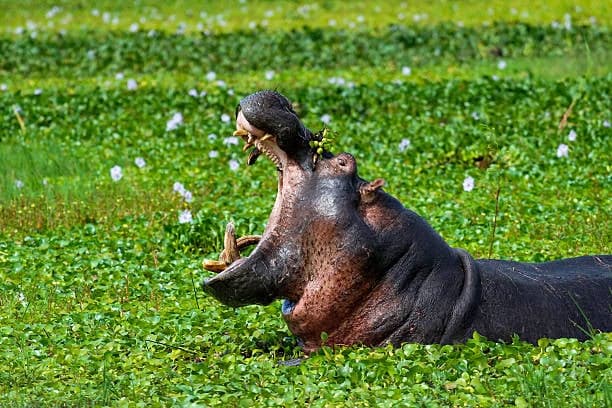
- Boat safaris on Lake Ihema, the largest of the park's lakes, among hippos and crocodiles
- More than 500 recorded bird species, including the rare shoebill stork and papyrus gonolek
- Giraffes, zebras, topis, elands, impalas and waterbucks on the savannah
- Night game drives revealing leopards, hyenas and nocturnal wildlife
- A scenic mosaic of lakes, wetlands and acacia woodland framed by rolling hills
Game drives traverse remarkably varied country, from lake-shore wetlands where fish eagles call to open grassland where reintroduced lion prides have flourished. The Lake Ihema boat safari is the park's signature second act: hippo pods, basking crocodiles and dense waterbird colonies along the papyrus edge. Birdwatchers rate Akagera among East Africa's finest wetlands destinations, with the shoebill the ultimate prize.
The park's revival — managed in partnership between the Rwanda Development Board and African Parks — balances wildlife protection, community engagement and sustainable tourism, and stands as proof of how quickly a landscape can recover when properly resourced. The timeline tells the story: after the park's wildlife was devastated in the aftermath of the 1994 genocide, management was rebuilt from 2010, lions returned in 2015 after a two-decade absence, and eastern black rhinos followed in 2017 — restoring the full Big Five within a single decade.
For visitors, the practical experience is refreshingly flexible. A typical itinerary enters through the southern gate near Lake Ihema, game-drives north through the lake country and savannah over a full day, and overnights at a lodge or tented camp before exiting via the northern gate — effectively traversing the whole park without retracing a road. Guided fishing on the lakes, behind-the-scenes conservation talks and community-run cultural experiences on the park boundary round out the options, and because Akagera sees a fraction of the vehicle numbers of Kenya's or Tanzania's flagship parks, even peak-season game drives feel private. Accommodation spans the full range, from community-run campsites to mid-range lodges and exclusive lakeside camps, so the park works equally well as a weekend escape from Kigali or the savannah finale of a longer Rwandan journey.
When Is the Best Time to Visit Akagera?
June to September, the long dry season, is best for game drives, with wildlife concentrated near the lakes. The wetter months from October to May bring migratory birds, lush scenery and lower visitor numbers, keeping the park rewarding year-round.
How Do You Get to Akagera?
The park lies approximately 110 kilometres from Kigali, a drive of about 2.5 to 3 hours on good roads — making it one of Africa's most accessible Big Five destinations. Most visitors arrive via the southern entrance and exit through the north after traversing the park.
How Many Days Do You Need?
Two nights is ideal: a full-day game drive through the park's length, a Lake Ihema boat safari and an optional night drive. Travellers short on time can manage a long day trip from Kigali, though an overnight stay is far more rewarding.
Akagera pairs naturally with Volcanoes National Park and Nyungwe Forest on a one-week Rwanda circuit, adding classic savannah wildlife to the country's primate experiences. Few itineraries anywhere pack gorillas, chimpanzees and the Big Five into so few driving hours, which is precisely Rwanda's growing appeal.